


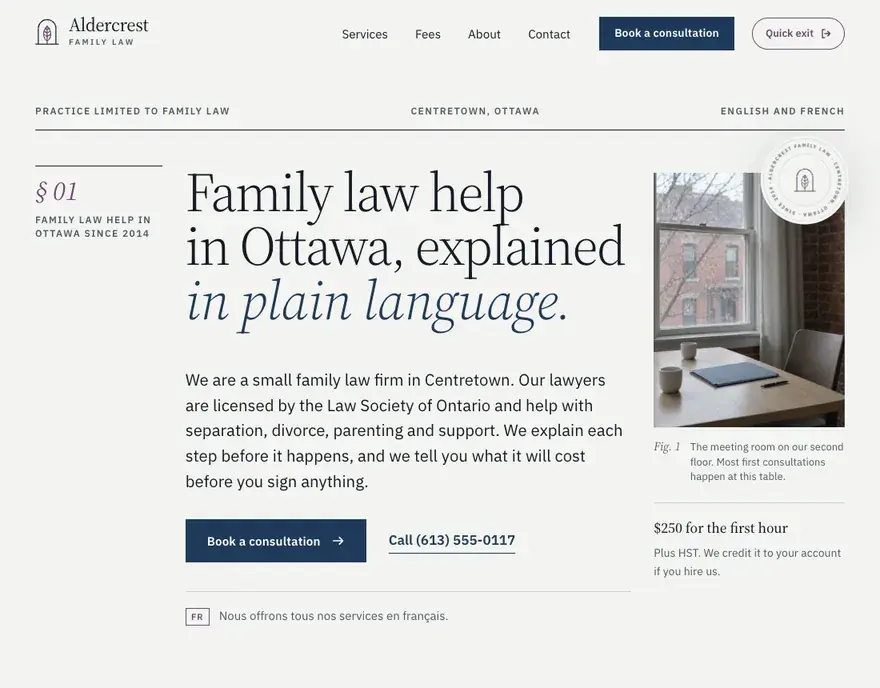
What people look for on a law firm website
Most people who visit a lawyer’s site are dealing with a stressful event, such as a separation, a house purchase or a death in the family. They want to find out quickly whether you handle their kind of matter and what the first step costs. Before they call, they usually check:
- Whether you practise the area of law they need, in their city or court.
- Who they will work with, with a photo and a short profile for each lawyer.
- How you charge, and whether the first consultation has a fee.
- Whether you meet by video, in the evening or in French.
- A way to reach you that does not ask for case details up front.
The pages a law firm website needs
- A homepage that names your practice areas and your city in the first lines, with a phone number and a button to book a consultation.
- One page for each practice area. Explain the process, the documents a client will need, a rough timeline and how you bill for that type of work.
- A profile page for each lawyer and law clerk, with year of call, languages and practice areas.
- A fees page with your hourly rates, flat fees and any retainer you ask for.
- Short articles that answer the questions clients ask on the first call. These also help people find you through search.
- A contact page with an intake form, office hours, a map and parking or transit details.
If you already have a site that does not do these things, our website redesign service keeps your existing addresses and content where it makes sense.
Ontario marketing rules your website must follow
The Law Society of Ontario treats your website as marketing. Section 4.2 of the Rules of Professional Conduct sets the rules. Marketing must be true, accurate and verifiable, and it must not mislead, confuse or deceive. A law firm website should avoid:
- Words such as “best”, “top” or “#1”, and any claim you cannot prove.
- Calling yourself a “specialist” or “expert” unless the Law Society has certified you as a specialist. Rule 4.3 covers this.
- Listing past wins or settlement amounts in a way that suggests the next client will get the same result.
- Describing yourself or your firm as aggressive.
- Awards, rankings or endorsements that are not genuine or that you paid for.
- Offering “second opinion” services, which rule 4.2-1.2 prohibits.
Rule 4.2-1.1 requires your marketing to say that you are licensed as a lawyer. If you publish a fee, rule 4.2-2 expects it to be reasonably precise about the services it covers, to say whether HST and disbursements are extra, and to be the fee you charge in every case. We write each page with these rules in mind. You are the licensee, so you approve the final text, and you should check the current rules on the Law Society site before launch.
How clients find a lawyer on Google
Many clients look for a lawyer near where they live, so local search matters. A law firm site helps Google match you to those searches:
- A page for each practice area, written around the words clients use, such as “divorce lawyer Ottawa” or “real estate lawyer Kanata”.
- Your firm name, address and phone number, matching your Google Business Profile exactly.
- Answers to common questions, written in plain language and kept up to date.
- Pages built for phones first, because Google reads the mobile version of your site.
We cannot promise a ranking. Our local SEO service covers the ongoing work if you want help after launch.


