


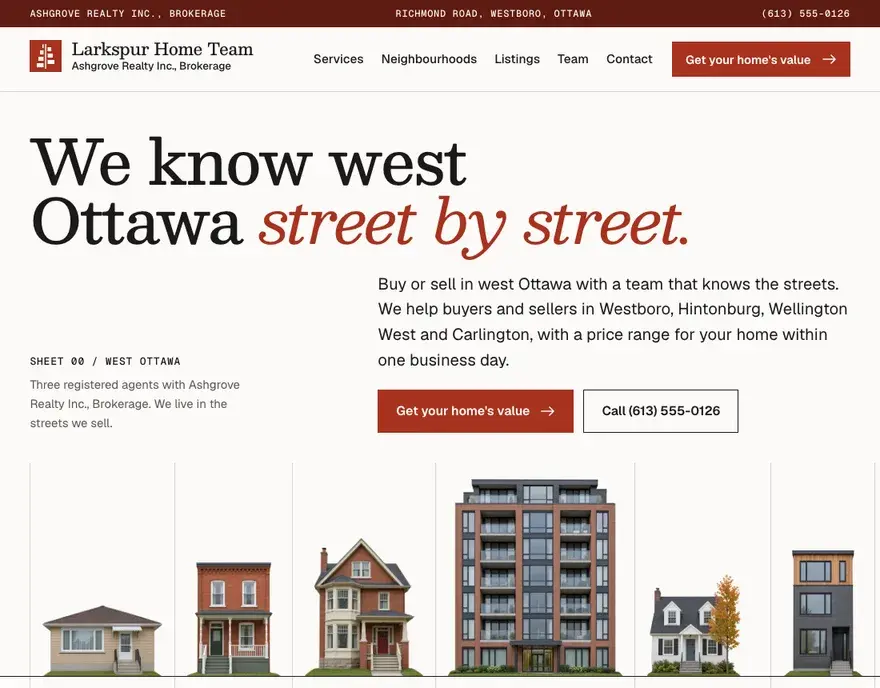
What buyers and sellers check before they contact an agent
Two kinds of people visit an agent’s site. Buyers want to look at homes. Sellers want to know what their home is worth and whether you can sell it. Many people look up a few agents before they reach out, often after they see a sign or get a referral.
A buyer usually wants to know:
- Can I search current listings here without being forced to sign up first?
- Does this agent know the neighbourhoods I am looking at?
- How do I book a showing?
A seller usually wants to know:
- What is my home worth right now?
- What has this agent sold near me, and how fast?
- What does the agent do to market a listing, and what does it cost?
Realtor website design works when each group finds its answer in one or two clicks. That means separate paths for buyers and sellers from the homepage, with a clear next step on each.
Listing feeds from CREA DDF and board IDX
Ontario agents have two main ways to show MLS® listings on their own site.
- CREA’s REALTOR.ca DDF® is a data feed run by the Canadian Real Estate Association. It includes a member website feed for your own listings and a national shared pool of listings that brokerages have agreed to share. Your broker owner controls the permissions.
- A board IDX feed comes from your local real estate board, such as the Ottawa Real Estate Board. It shows listings from brokerages on that board, under the board’s display rules.
Either feed updates your site when a listing changes on the MLS® System, so you never show a home that sold last week. We connect the feed through a listing provider that is approved for your board, and we style the search and listing pages to match your brand. The provider charges its own monthly fee, separate from our prices.
RECO advertising rules for your website
In Ontario, the Real Estate Council of Ontario (RECO) enforces the advertising rules under the Trust in Real Estate Services Act, 2002 (TRESA). A website counts as advertising. The rules that affect your site come from RECO Bulletin 5.1 on advertising requirements and RECO Bulletin 5.3 on advertising online:
- Your employing brokerage must be clearly and prominently identified, using the name registered with RECO. RECO says team websites often get this wrong.
- Use your name exactly as it is registered, with no nicknames or short forms.
- Describe yourself with a permitted term for your registration, such as salesperson, broker or broker of record. REALTOR® is only for members of CREA.
- A personal real estate corporation (PREC) must not appear as the business that trades in real estate.
- Get written consent before you post a seller’s name with a price, or a client testimonial.
- Claims such as “top producer” need a source, a date and an explanation of how they were measured.
- Links to other websites must make it clear that the visitor is leaving your site.
We build these into the template, so a new page cannot go live without the brokerage name. Your broker of record still has the final say on what the site claims.
Lead capture that follows anti-spam law
Listing alerts, market reports and newsletters are commercial emails under Canada’s Anti-Spam Legislation (CASL). A person who asks you a question has given implied consent for a limited time. The CRTC’s guidance on implied consent explains the time limits. For ongoing emails, you need express consent.
On your site, that means:
- An unchecked box the visitor ticks to agree.
- Your name and brokerage beside the box, so they know who will email them.
- A plain note that they can unsubscribe at any time.
Every form also sends the lead to your CRM, such as Follow Up Boss or Lofty, with the page it came from. You know whether a lead came from the valuation form or a listing in Barrhaven.
Neighbourhood pages and home valuations
Neighbourhood pages show buyers that you know the area. A good page for Westboro or Orléans covers:
- The types of homes and the usual price range.
- Schools, parks, transit and commute times downtown.
- Your recent sales in the area, with the seller’s consent.
- Current listings in that area, pulled from the feed.
These pages give Google something specific to show for searches like “homes for sale in Kanata Lakes”. We cannot promise where you will rank, but a page about a neighbourhood has a much better chance than a homepage that lists 20 area names.
The home valuation form is the page that brings in sellers. Keep it short, with the address first, then bedrooms, bathrooms and planned timing. You reply within a day with a price range and your recent sales nearby.
The pages a real estate website needs
- Homepage with separate buttons for buyers and sellers.
- Search and listing pages from your MLS® feed.
- Your own featured listings, with a full photo gallery, floor plans and a showing request form.
- One page for each neighbourhood you work in.
- A home valuation page.
- A selling page that explains how you market a home.
- About page with your registration, brokerage and reviews.
- Contact page with your phone number, office address and brokerage details.
See our web design service for how we build each page, and our local SEO service if you want help with your Google Business Profile.


